Trees add shade, privacy, beauty, and value to a property, but they can become a serious concern when they grow too close to a house, garage, office, or other structure. Large branches can scrape against roofs, roots can affect foundations and underground utilities, and weakened trees can become dangerous during strong winds or storms. Removing a tree near a building is therefore very different from cutting down a tree in an open yard.
Yes, a professional Tree Removal Company can usually remove trees located close to buildings. However, the work requires careful planning, specialized equipment, and an understanding of how the tree can be safely dismantled without damaging the structure. The goal is not simply to cut the tree down. It is to control where every branch and section of the trunk goes during the removal process.
Why Trees Near Buildings Can Be Difficult to Remove
A tree standing in an open area can often be cut and allowed to fall in a controlled direction. That approach is not practical when a house, garage, fence, power line, driveway, or neighboring property is nearby. Even a relatively small mistake can result in broken windows, roof damage, damaged siding, or other expensive repairs.
The size and condition of the tree also matter. A mature tree may weigh several thousand pounds, and individual branches can be surprisingly heavy. Dead branches can be particularly unpredictable because they may break before the worker expects them to.
Common Risks Around Buildings
Several factors make trees near structures more challenging:
- Limited space for the tree to fall
- Large branches extending over roofs
- Weak, dead, or diseased limbs
- Sloped or uneven ground
- Nearby power lines
- Fences, vehicles, pools, or landscaping
- Underground utilities
- Poor tree structure or multiple trunks
- Strong wind or changing weather conditions
A professional assessment helps determine which removal method is appropriate before any cutting begins.
How Professionals Remove Trees Close to Structures
When there is not enough room to safely fell an entire tree, professionals usually remove it in sections. This allows the crew to control the movement of branches and pieces of the trunk rather than allowing the whole tree to fall.
Climbing and Sectional Removal
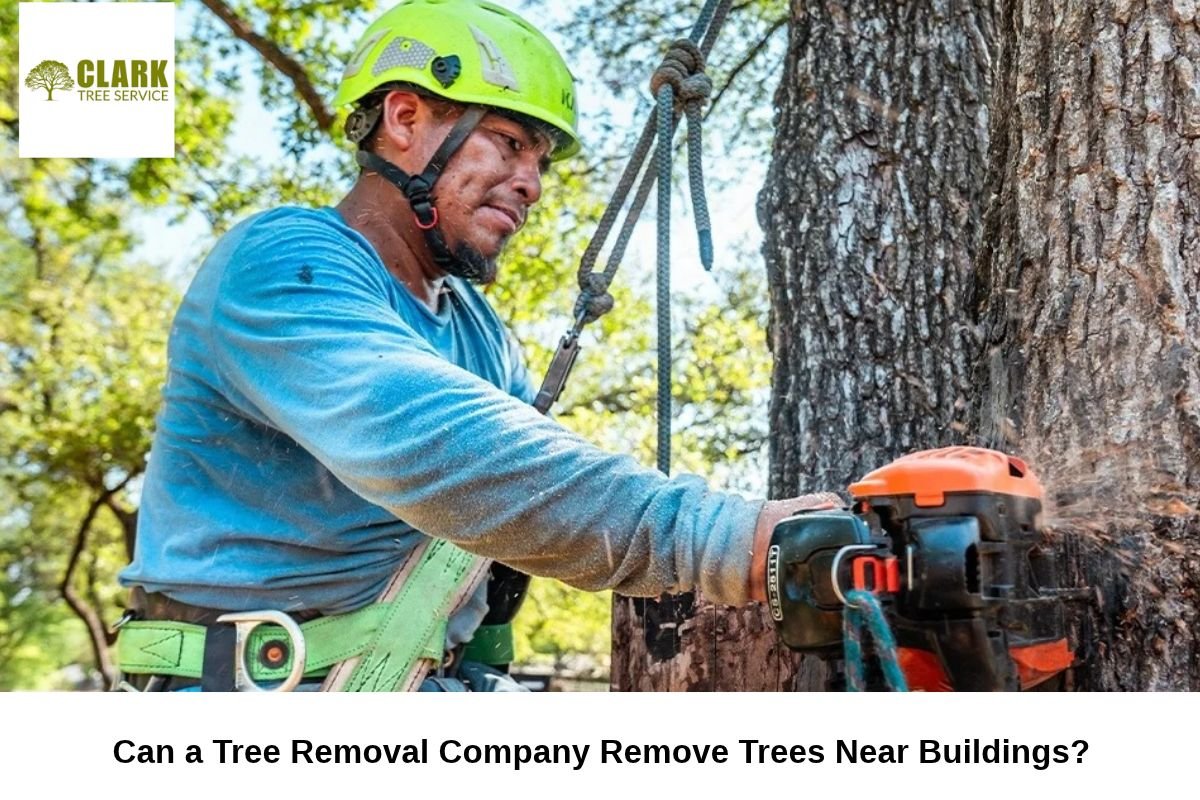
For trees in confined spaces, an experienced arborist may climb the tree and remove branches individually. Larger sections of the trunk can then be cut into manageable pieces.
Depending on the location, equipment such as ropes, lowering systems, bucket trucks, and cranes may be used. The choice depends on the tree’s size, location, surrounding structures, access to the property, and ground conditions.
Crane-Assisted Tree Removal
A crane can be useful when a large tree is positioned between a building and other obstacles. Instead of allowing heavy sections to fall, the crew can attach them to a crane and move them away from the structure.
This method can reduce the risk of impact damage and may also make the job faster in certain situations. However, the property must have sufficient access and ground conditions to safely support the equipment.
Directional Felling
Sometimes a tree can be safely felled in one piece if there is enough clear space and the tree’s condition allows it. Professionals evaluate the lean of the tree, wind conditions, available landing area, and nearby hazards before choosing this method.
A tree should never be felled toward a building simply because that appears to be the easiest direction.
What Should You Check Before Tree Removal?
Homeowners should not wait until a tree falls or causes visible damage before considering professional advice. Regular inspections can identify warning signs that indicate a tree may require pruning, treatment, or removal.
Signs a Tree May Be a Risk
Look for:
- Large dead branches
- Cracks in the trunk
- Significant trunk decay
- Fungal growth around the base
- Leaning that has recently developed
- Exposed or damaged roots
- Cavities in major branches
- Branches touching the roof
- Repeated limb breakage
- Soil movement around the root area
A leaning tree is not automatically dangerous, and some healthy trees naturally grow at an angle. The important issue is whether the tree has changed recently or shows other signs of structural weakness.
Check for Utilities and Access
Before removal begins, identify overhead power lines and other utility concerns. Underground utilities may also affect where heavy equipment can operate or where stump grinding can take place.
Homeowners should also tell the contractor about irrigation systems, septic systems, buried cables, and other features that may not be visible from the surface.
How Much Does Tree Removal Near a Building Cost?
The price varies considerably from one property to another. A small tree in an accessible location may be relatively straightforward, while a large tree overhanging a two-story house may require specialized equipment and several workers.
Factors that can affect the price include tree height, trunk diameter, species, condition, location, access, removal method, disposal requirements, and whether stump grinding is included.
For example, removing a healthy tree from an open backyard is generally less complicated than dismantling a large, damaged tree positioned directly above a roof. A contractor may also charge more when a crane, bucket truck, traffic control, or additional safety equipment is required.
Get a Written Estimate
Before approving the work, ask for a written estimate that explains what is included. It should make clear whether the price covers cutting, removal of branches and logs, cleanup, stump grinding, and any other services.
Do not choose a contractor based solely on the lowest price. Tree removal is hazardous work, and inadequate equipment or experience can increase the risk of property damage and personal injury.
Does Homeowners Insurance Cover Tree Removal?
Insurance coverage depends on the policy and the circumstances that caused the tree to fall or become damaged. In many U.S. homeowners insurance policies, removal of a fallen tree may be covered when the tree falls because of a covered event and damages an insured structure, subject to policy terms, deductibles, and coverage limits.
Coverage can be different when a tree falls without damaging covered property. Preventive removal of a healthy tree because a homeowner is concerned about a possible future problem is generally not the same as removal after a covered loss.
Homeowners should review their policy or contact their insurance company before assuming that tree removal will be covered. Ask specifically about tree removal limits, fallen-tree coverage, debris removal, deductibles, and damage to structures.
How to Choose a Qualified Tree Removal Contractor
Because trees near buildings create additional hazards, experience matters. Look for a contractor that regularly handles residential removals in confined spaces and can explain how the crew plans to protect your home and surrounding property.
Ask These Questions
Before hiring a contractor, consider asking:
- Are you insured for property damage and worker injuries?
- Who will perform the work?
- What removal method do you recommend?
- How will you protect my roof, windows, landscaping, and other property?
- Is cleanup included in the estimate?
- Will you grind or remove the stump?
- Do you have references or recent examples of similar work?
Professional credentials can also provide useful information. Depending on the type of work, homeowners may want to look for an ISA Certified Arborist or a company with appropriate local licensing and insurance.
Do not hesitate to request proof of insurance. A reputable contractor should be able to provide documentation rather than asking homeowners to take their word for it.
What Homeowners Can Do Before the Crew Arrives
There are several simple steps homeowners can take to make the work safer and easier. Move vehicles away from the work zone and keep children and pets indoors. Remove outdoor furniture, decorations, planters, and other movable objects from the area whenever the contractor recommends it.
Keep windows and doors closed during removal, particularly when branches are being lowered near the home. If the crew identifies a specific access route, keep that area clear so equipment can reach the work site.
It is also useful to photograph the property before work begins. Pictures of the roof, siding, fences, landscaping, and other nearby features can provide a record of their condition before removal.
When Tree Removal May Be the Wrong Solution
Not every tree near a building needs to be removed. In some cases, professional pruning can reduce the risk while allowing the tree to remain healthy.
A qualified arborist may recommend removing selected branches, reducing weight in specific areas, or monitoring the tree over time. This can be a better choice when the tree is structurally sound but has branches that are growing too close to the building.
Removal is generally considered when the tree is dead, severely damaged, structurally unstable, diseased beyond treatment, or positioned in a way that creates an unacceptable risk.
The right decision should be based on the tree’s actual condition rather than its size or proximity alone.
Frequently Asked Questions
Can a tree be removed if it is touching a house?
Yes. Professionals can often dismantle a tree piece by piece when it is touching or growing over a house. The removal method depends on the tree’s size, condition, access, and surrounding hazards.
How do professionals prevent a tree from falling on a building?
They may remove branches and trunk sections gradually using ropes, lowering systems, lifts, or cranes. The method is selected according to the property’s specific conditions.
Should I remove a tree that is leaning toward my house?
Not necessarily. A lean can be natural, but a recent change in angle, trunk cracks, root damage, or dead branches may indicate a structural problem. A professional inspection can help determine the risk.
Does homeowners insurance pay for tree removal?
It depends on the policy and cause of the damage. Many policies provide some coverage when a fallen tree damages covered property because of a covered event, but exclusions, deductibles, and limits may apply.
Can I remove a tree near power lines myself?
Homeowners should not attempt this. Trees and power lines can create a serious electrocution hazard. Contact the utility company or a qualified professional who is equipped to handle the situation safely.
Is stump removal included with tree removal?
Not always. Stump grinding or complete stump removal may be a separate service. Ask the contractor to specify exactly what is included in the written estimate.
How can I protect my house during tree removal?
Choose an insured, experienced contractor and ask how the crew plans to control branches and trunk sections. Clear the work area and follow the contractor’s safety instructions before removal begins.
Conclusion
A tree close to a house or other building can usually be removed safely when the work is properly planned and performed by experienced professionals. Sectional removal, ropes, lifts, and cranes can help crews control heavy branches and trunk sections in areas where traditional tree felling is not practical.
Homeowners should also consider whether pruning could solve the problem before choosing complete removal. If removal is necessary, compare written estimates, verify insurance, ask about the proposed method, and understand exactly what services are included.
If you have a tree growing over your roof, next to your garage, or close to another structure, arrange a professional assessment before attempting to cut it yourself. Early action can help reduce the chance of costly property damage and make the eventual work safer.